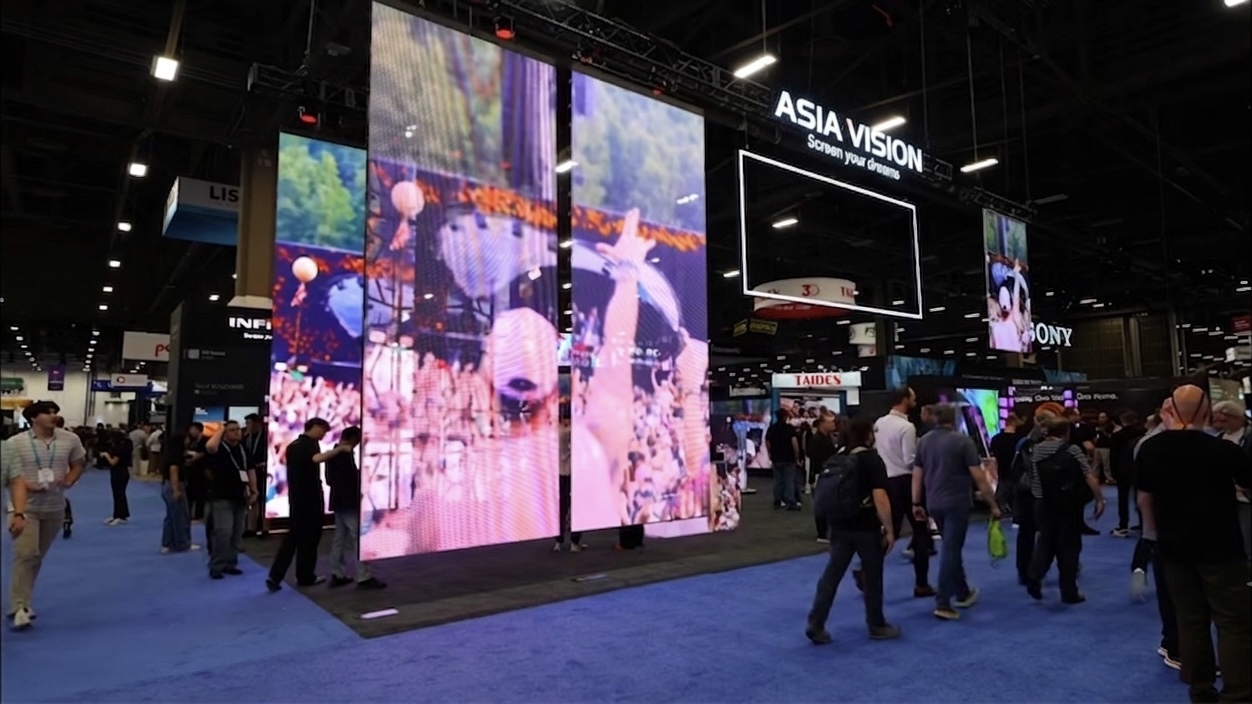
A double-sided LED display shows content on both faces of a single unit. The two faces are usually driven independently, so each can run different content, and they are mounted back to back on a shared spine or frame. The format is common in pillars, hanging signs in atriums and concourses, freestanding totems in lobbies, and outdoor cabinets where two directions of traffic need to be addressed at once.
The alternative would be two separate screens fixed back to back, and sometimes that is the right answer. But an integrated double-sided unit shares one power supply, one control path, and one mounting frame, which reduces cost, cable runs, and visual bulk. In a space where the mounting point is a single structural element, the integrated unit is often the only clean option.
Double-sided displays solve a specific problem: an audience approaching from two directions. A pillar in a shopping mall, a hanging sign over a concourse, or a totem in a hotel lobby all see traffic from both sides. One screen faces a wall of blank cabinet from the other side, which wastes the viewing opportunity.
The format also lets a venue speak to two audiences at once. A retail pillar can show a product campaign facing the walkway and wayfinding facing the seating area. An event venue can show a sponsor on one face and the running order on the other, with each face independently scheduled.
This guide covers the main double-sided formats, how to handle viewing angles on both faces, structural and power considerations, and how to plan content for two audiences.
The pillar format wraps the unit around a structural column, often with four faces rather than two. Two-sided versions cover the two faces that see traffic, while a four-sided wrap makes the column a landmark from every direction. Pillar screens are usually built from narrow cabinets or flexible modules so the unit follows the column's shape or forms a clean box around it.
The hanging format suspends the unit from a ceiling, double-sided and often slim, so it reads from below and from both approaches. Hanging signs work in atriums, airport concourses, exhibition halls, and shopping centres where the ceiling can carry the load and the sightline overhead is clear. Weight and rigging are the governing constraints here, because everything hangs.
The freestanding format stands a totem on the floor, double-sided, with a weighted base or a bolted foot. Totems suit lobbies, entrances, and exhibition stands, and they are the easiest of the three to relocate. They also carry the load and stability requirements of any freestanding structure, so a tall totem needs a base heavy enough to resist being pushed or leaned on.
A fourth variation is the two-faced wall unit, where a screen serves two rooms separated by a partition, one face to each side. This is common in venues with a divisible hall, and it requires a design that keeps the cabinet body thin enough to fit the partition while still dissipating heat from both faces.
Each format has a different service story. A totem can be opened from the floor, a hanging unit needs a lift or a walkway above, and a pillar wrap needs front-serviceable modules because access behind the column is impossible.
| Format | Faces | Mounting | Typical Location | Service Access |
|---|---|---|---|---|
| Column pillar | 2 or 4 | Wrap around structural column | Malls, lobbies, stations | Front service required |
| Hanging sign | 2 | Ceiling rig with lift point | Atrium, concourse, hall | Lift or overhead walkway |
| Freestanding totem | 2 | Weighted base or bolted foot | Entrances, exhibition stands | Floor-level opening |
| Divider wall | 2 | Thin body in partition | Divisible halls, studios | Both rooms, one face each |
| Outdoor gantry | 2 | Steel gantry on posts | Roads, plazas, car parks | Rear or front service, IP65 |
A double-sided unit faces two audiences who may have nothing in common. One face may look down a long corridor, the other into a bright open space. That means brightness and pitch are set per face, not for the unit as a whole, and the two faces may be genuinely different specifications.
Horizontal viewing angle decides how far off-axis the image still reads. An LED module holds brightness and colour across a range of angles, and beyond that range the image dims and shifts. On a pillar, viewers pass close by at a steep angle, so a wide viewing angle matters more than it would on a wall viewed head-on.
Brightness is set by the environment behind each viewer. A face looking into a sunlit atrium needs more output than a face over a shaded walkway, and matching the two to each other is a mistake. Each face should be tuned to its own viewing conditions, and where the venue changes light conditions by day, scheduled brightness profiles keep both faces readable without glare.
Slimness and brightness fight each other. A thin double-sided unit has little room for heat dissipation, so a very bright slim unit runs hotter and needs more careful cooling. Where the design demands both slim profile and high brightness, the thermal path becomes the limiting factor and the cabinet depth must grow to accommodate it.
Finally, consider the join between the faces. On a pillar wrap the corners are visible, so the corner cabinet needs careful calibration and a clean edge. On a hanging sign the top and bottom edges are seen from below, so the frame should look finished from every angle, not just from the two viewing directions.
| Environment | Typical Brightness | Pitch Range | Notes |
|---|---|---|---|
| Indoor lobby or mall | 800 - 1500 nits | P1.9 - P3.9 | Tuned per face to local light |
| Atrium with daylight | 1500 - 2500 nits | P2.6 - P4 | Hanging units need overhead clearance |
| Outdoor plaza or gantry | 5000 - 8000 nits | P4 - P10 | IP65 body, sealed both faces |
| Direct-sun outdoor roadside | 8000 - 10000 nits | P6 - P10 | Highest output, rear service often |
| Divider wall indoor | 800 - 1200 nits | P1.9 - P2.6 | Thin body, low heat per face |
Structure governs a double-sided install because the unit is often mounted where access is awkward. A hanging unit concentrates its load on a small ceiling footprint, so the rigging design and the ceiling's capacity must be verified before the unit is sized. A freestanding totem spreads the load through a base, and that base has to be sized for wind and for people leaning against it. A pillar wrap loads the column, so the column itself becomes part of the structural conversation.
Power is a single feed into a shared supply, which keeps the cable run tidy but means a fault on the supply takes both faces dark. Where the venue can tolerate neither face going dark, the two faces are sometimes given separate supplies so one can continue while the other is serviced. That split also lets one face be powered down overnight while the other stays on for security or wayfinding.
Independent control is a design choice with real benefits. Two faces on one processor can show a single synchronised image or two separate feeds, depending on how the operator drives them. Separate content per face needs its own source routing and playlist, which a processor with two outputs and layer control can deliver from a single control point.
Content strategy follows the audience. A double-sided unit usually addresses two different groups, so duplicating a campaign wastes the format. Retail pillars show a product on the walkway side and navigation on the seating side; venues show sponsors on one face and schedules on the other; hotels show branding outward and wayfinding inward.
Finally, plan the content refresh so both faces receive attention. It is easy to keep one face current and let the other go stale, which looks careless to the half of the audience that only ever sees the neglected side. A single content calendar covering both faces, with a shared fallback loop, keeps the unit consistent.
Asia Vision Technology builds double-sided LED units in pillar, hanging, totem, and gantry formats, with independently driven faces and brightness tuned per face. Our D-PRO outdoor line runs 5000 to 10000 nits in an IP65 body, while the indoor CV-PRO platform covers fine pitch for lobby and atrium units.
All products carry CE, FCC, and RoHS certification and ship in 15 to 20 working days with a 3-year warranty. We supply load data, rigging points, and per-face power figures up front so the structural and electrical design is settled before the unit is built.
For this requirement our range covers it directly: the COB EF outdoor series (IP65, 3000 nits) and the D-PRO outdoor series (front maintenance).