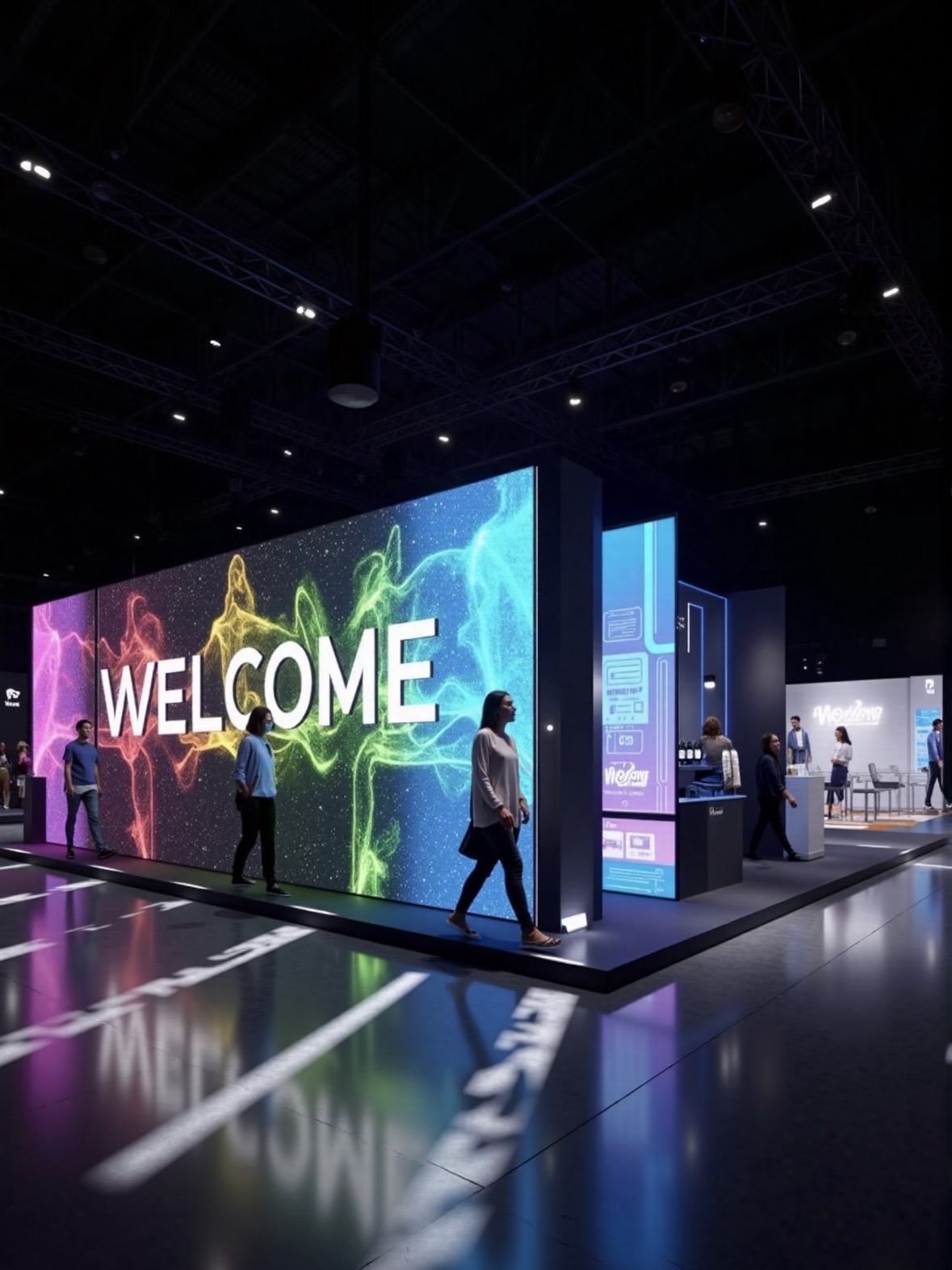
An LED wall project succeeds or fails in the signal chain long before anyone judges the picture. Integrators who treat the screen as one component inside a wider AV system deliver installations that switch, scale and fail over cleanly. This guide covers the integration decisions that sit between the source and the panel.
End users no longer buy a display and a separate control room. They buy a room that behaves predictably: a boardroom where the laptop, the video conference codec and the room camera all appear on one wall, a lobby where the wall switches from a welcome graphic to a live feed without a technician present, and an auditorium where the stage screen and the confidence monitors stay in frame lock across a two-hour session. Integration is the discipline that makes those outcomes repeatable.
LED is pulling more of this work onto the integrator's desk because the panel is only the last metre of a long chain. Unlike a projector, an LED wall has no fixed native resolution to fall back on; it has a pixel count set by the cabinet array, and everything upstream has to be scaled, mapped and routed to match that exact geometry. Get the mapping wrong and the image either crops or letterboxes, which clients notice immediately.
Control is the second driver. A modern AV project expects one touch panel, one scheduling system and one set of presets. That means the LED processor has to speak a control protocol the building system already understands, and it has to report status so a facility team can see whether the wall is on, what source is live and whether a receiving card has dropped out. Displays that cannot be monitored become a support burden.
Finally, power and heat planning has moved earlier in the design process. A large fine-pitch wall draws real current and produces real heat, and the electrical contractor needs load figures before the ceiling is closed. Integrators who can hand over an accurate power budget and rack layout save the whole project from a late redesign.
A fifth driver is serviceability. A wall that cannot be diagnosed remotely generates truck rolls, and a site with dozens of screens cannot afford to send a technician for every glitch. Integrators are therefore specifying displays that report status, log faults and allow a firmware update over the network, so the first visit is the one that fixes the problem rather than the one that identifies it. That expectation has moved down from enterprise boardrooms into ordinary meeting rooms and retail spaces, and it changes which products are shortlisted.
The last driver is standardisation across a client's estate. A chain, a university or a hospital group does not want a different setup in every building; it wants a repeatable design that its own facilities team can support. Integrators who work with a single supplier on consistent cabinet sizes, mounting details and control interfaces can roll the same drawing out across many sites, and the client's maintenance staff learn one system instead of six. That repeatability is worth more over a decade than a marginal saving on the first order.
Budget cycles shape timing too. Many AV projects are funded in a single financial year and must be installed before it closes, which compresses the window between approval and commissioning. A supplier on a documented 15 to 20 working day cycle gives the integrator room to confirm the design, order the panels and still leave time for installation and calibration, whereas a longer or less predictable lead time forces the integrator to either rush the commissioning or push the project into the next budget period.
Plan the chain backwards from the panel. Start with the wall's pixel dimensions, then choose a video processor that can output exactly that canvas and scale arbitrary sources into it. Confirm the number of inputs the room really needs, including at least one spare, and confirm that the processor supports the source standards the client uses, such as 4K and the common baseband and streaming formats a control room will feed it.
Then design the rack and the power. Receivers, sending cards, the processor, network switches and the control gateway should be laid out so a single fault can be isolated without unplugging a dozen cables. Build in signal redundancy where the venue cannot tolerate a dark wall, and separate control traffic from video traffic on the network so a misconfigured device cannot disturb the picture. Ventilation and service access belong in the drawing at the same time as the equipment list.
Cable management deserves more attention than it usually receives. The distance between the rack and the wall sets the maximum run length for each signal type, and a run that exceeds it needs an extender, a fibre link or a change of topology. Power, data and control should be separated along their routes so that a mains cable does not run alongside an unshielded data line for ten metres. Labelling both ends of every cable is a small discipline that turns a future fault from a day of tracing into a five-minute fix.
Commissioning should be planned as a phase, not squeezed into the last afternoon. A wall needs a calibration pass to match cabinets, a test of every source at its native resolution, a check of the control sequences and a deliberate fault test to confirm the redundancy behaves as designed. Building that time into the programme protects the integrator from the client's first impression being an uncalibrated wall with a flickering tile.
| Application | Series | Key Specs |
|---|---|---|
| Corporate boardroom wall | CV-PRO P1.2 | Fine pitch, 3840Hz refresh, camera-safe |
| Control room video wall | CV-PRO P1.5 | Colour-accurate, low latency, 24/7 rated |
| Auditorium stage screen | X Series P2.6 | 500x500mm cabinet, 6.5kg, quick rig |
| Lobby and reception feature | CV-PRO P1.8 | 10000:1 contrast, slim front service |
| Outdoor atrium signage | D-PRO P4 | IP65, 8000+ nits, high ambient |
Integrators need a screen supplier that behaves like a partner on the drawing, not a box shipper. Asia Vision Technology supports AV projects with complete signal-chain documentation: pixel dimensions, sending card capacity, receiver count, power budget and rack drawings, all supplied before the first cabinet is built. That lets the electrical and AV contractors coordinate on real numbers instead of estimates.
Our products carry CE, FCC and RoHS certification, ship on a 15 to 20 working day cycle and include a three-year warranty, which lines up with the maintenance window most AV clients plan around. Because we manufacture the CV-PRO, COB, X and D-PRO families ourselves, a project that needs a custom cabinet size, an unusual aspect ratio or a specific control protocol can be met at the factory. We also keep spare receiving cards and power supplies matched to each build so a service call is a straight swap.
For integrators who standardise on a supplier, that consistency pays off across a portfolio. A campus, a retail chain or a corporate estate with the same panel family in every room needs one spare kit, one configuration template and one control integration, rather than a different puzzle in each building. We support that approach by keeping cabinet sizes, mounting patterns and control interfaces consistent across the CV-PRO range, so an integrator's standard detail drawings work in the next project without redesign.
We also make the commissioning handover a documented deliverable rather than a verbal walkthrough. An integrator receiving a wall should get the pixel dimensions, the processor configuration, the control integration notes and the power budget in writing, so the next engineer who touches the system does not have to reverse engineer it. That record protects the integrator's warranty position with the client and makes the supplier relationship one that can be repeated across projects rather than renegotiated each time.
For this requirement our range covers it directly: the COB Z rental series (7680Hz flip-chip) and the COB ZH touring series (sealed, wind-rated).
Need LED display solutions?
Contact Asia Vision for competitive pricing and specs.
📩 Get a Quote WhatsApp