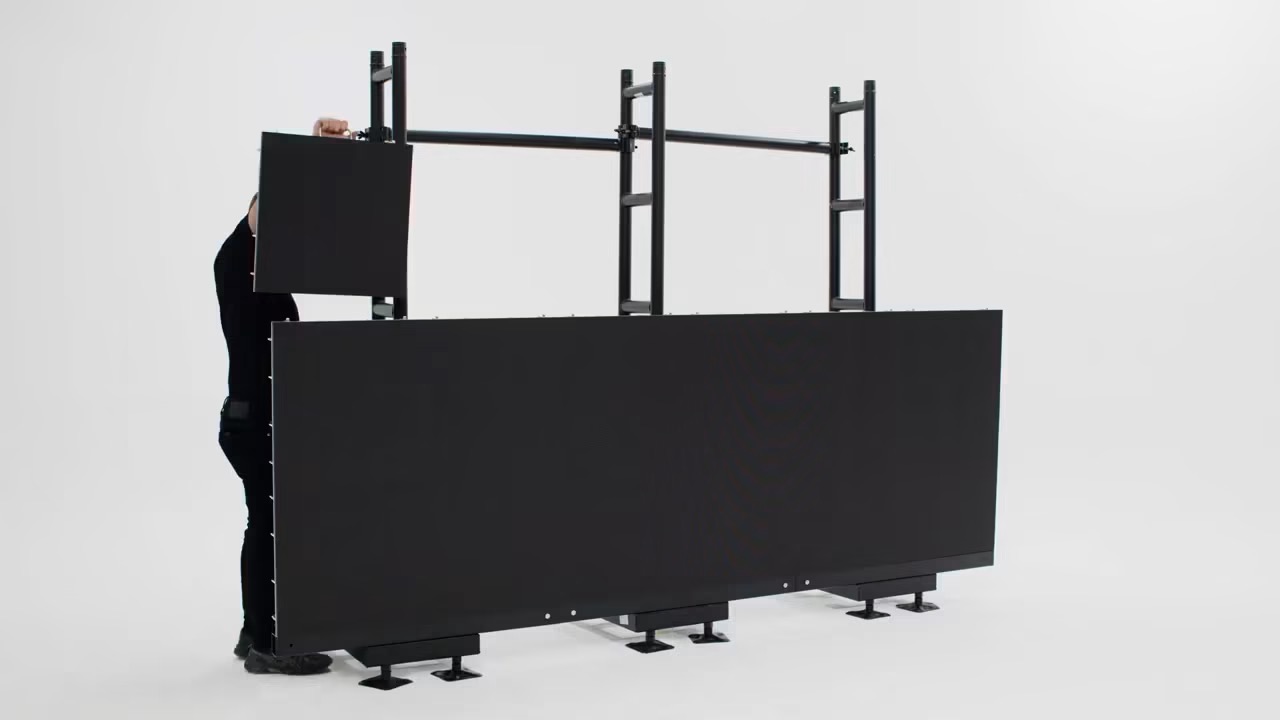
Importing LED displays and digital signage from China to the United States involves certification, sea freight from Shenzhen to Los Angeles or New York, customs clearance under HTS 8528.59, and careful supplier verification. Get the sequence right and the process is predictable; skip a step and a finished installation can be blocked by a single missing mark.
This guide follows the process in the order a first-time US importer should execute it, from choosing a manufacturer through to arranging payment and taking delivery. Distributors, AV integrators and event companies can use it as a checklist for their own procurement teams.
The single decision that determines whether an import runs smoothly is supplier selection. A manufacturer that already holds US-market certification removes weeks of uncertainty from the schedule, because UL or ETL listing and FCC authorisation cannot be retrofitted quickly to a finished cabinet. Ask for the certification file number before you ask for a quotation, and verify it independently.
Certification is only half the picture. A serious supplier will also permit a factory audit, whether on site in Shenzhen or by live video, and will allow sample testing before you commit to a production quantity. Build quality, solder integrity, power-supply brand and connector type are all visible in a teardown, and a manufacturer confident in its product will welcome that scrutiny rather than deflect it.
Commercial fit matters too. For the US market, confirm the supplier builds for 120V or 277V mains, supplies US-compatible plugs and certified power supplies, and can issue English documentation suitable for permits and insurance. Payment terms, warranty length and spare-parts logistics should be agreed before the first purchase order is raised, not negotiated in the middle of a failure.
Asia Vision Technology is an LED display manufacturer based in Shenzhen that supplies certified product to buyers in the United States, offering factory tours, sample testing and full compliance documentation. The following checklist is a practical filter for any supplier you evaluate.
Three certification families dominate US-market entry for LED displays. The first is safety listing through a Nationally Recognised Testing Laboratory, which for practical purposes means UL or ETL. Most state and local building codes require a listed product for commercial installation, and an inspector can halt a project on that single point.
The second is FCC authorisation. Because an LED display contains driver electronics and often a wireless or networked control module, it must comply with Part 15 rules for radio-frequency emissions. A display sold without FCC compliance risks customs delays and cannot be legally marketed as compliant equipment.
The third applies only to certain verticals: a sanitation listing is expected for displays used in food-service or food-retail environments, where washdown and cleanability matter. Not every project needs it, but a supplier serving the US market should be able to provide it for the models targeted at those applications.
Each certification is tied to a specific product series and takes weeks to obtain, which is why buying a certified product off the shelf is far faster than certifying a new design from scratch. Asia Vision maintains UL/ETL, FCC and sanitation listings so that US buyers can ship without waiting on a test cycle.
| Certification | Required For | Governing Framework | Asia Vision Status |
|---|---|---|---|
| UL / ETL Listing | Commercial installations under most building codes | UL 62368-1 and equivalent safety standards | Available |
| FCC Part 15 | All electronic devices marketed in the US | Part 15 emissions rules | Certified |
| ETL Sanitation | Food-service and food-retail displays | Sanitation listing standards | Available |
| RoHS | Restricted substances in components | Hazardous substance limits | Compliant |
| IP Rating Verification | Outdoor and wet-location cabinets | Ingress protection testing | Available |
Before comparing rates, understand how freight on large LED cabinets is actually charged. Ocean carriers bill on volume or weight, whichever is greater, and a fully packed 40-foot high-cube of cabinets will normally cube out before it weighs out. That means the practical question is how efficiently a supplier can pack modules, cabinets and flight cases into a container.
Air freight is charged on chargeable weight, which for bulky display hardware is driven by dimensional volume rather than actual weight. Air is therefore realistic only for samples, urgent replacement parts or a tight event deadline, and the premium over sea freight is substantial. Plan sea freight for production and reserve air for exceptions.
Route choice is a function of where the goods must end up. West Coast discharge is fastest to California and the Pacific Northwest. Rail intermodal from Los Angeles to Chicago or New York balances speed and cost for the Midwest and East Coast. All-water service to New York or New Jersey avoids rail transfer entirely and suits receivers close to the eastern seaboard.
Whichever route is chosen, add inland trucking, drayage and potential demurrage to the plan. Port congestion and chassis shortages can add days that a fixed installation date will not tolerate, so build a buffer into the schedule rather than assume the best case.
| Route | Transit Time | Characteristics | Best For |
|---|---|---|---|
| Shenzhen to Los Angeles / Long Beach | 14-18 days | Fastest water transit, high port volume | West Coast distribution |
| Shenzhen to LA plus rail to Chicago / NY | 18-22 days | Intermodal, balanced cost and speed | Midwest and East Coast |
| Shenzhen to New York / New Jersey | 25-30 days | All-water service, no rail transfer | East Coast direct delivery |
| Air freight via express carrier | 5-7 days | Highest cost, dimensional weight billed | Samples and urgent events |
LED displays and video walls enter the United States under HTS heading 8528.59, which covers monitors and display apparatus not elsewhere specified. Correct classification is the importer's legal responsibility, and an error in the code can trigger a penalty, a refund claim or an unplanned duty bill long after the shipment has cleared.
Duty liability depends on the applicable rate at the time of entry, and the picture has been complicated by trade-policy measures that can add, suspend or exclude tariffs for specific products. Because these measures change, importers should confirm the current rate with a licensed customs broker at the moment of booking rather than relying on a figure from a previous shipment.
Build the landed cost from its parts: the ex-works or FOB price, ocean freight, marine insurance, duty, the customs broker fee, and inland trucking to the warehouse. Duty is calculated on the customs value, which is generally the price actually paid for the goods, so a misstated invoice is both a compliance risk and an invitation to a valuation audit.
Buyers should also keep the entry summary, the commercial invoice, the packing list and the bill of lading together as a single file. If a certification question is raised later, or if a warranty claim depends on proving import dates, that file is the only reliable record. A reputable supplier provides matching paperwork as a matter of routine.
One more consideration is the bond. US importers generally need a customs bond, either a single-entry bond for a one-off shipment or a continuous bond for regular importing. A broker can advise which fits the shipment pattern, and continuous bonds become economical once imports are recurring.
Payment structure should protect both parties. The common arrangement for first orders is a deposit at order confirmation with the balance due before shipment. This gives the factory working capital to buy components while giving the buyer leverage to confirm the finished goods against the agreed specification before the balance is released.
Larger or repeat importers often prefer a letter of credit, which substitutes a bank undertaking for direct trust between buyer and seller. A letter of credit requires the documents to match its terms exactly, so it works best when the specification, inspection regime and shipping dates are unambiguous. For a first L/C it is worth having the bank review the wording before it is issued.
For samples, a small evaluation order of one or two cabinets is usually paid in full and shipped by air. This is a cost-effective way to inspect build quality, brightness uniformity and control software before committing to a production volume. Many importers test several suppliers in parallel this way.
Whatever the mechanism, put the specification in writing. Attach the agreed datasheet, pixel pitch, cabinet dimensions, brightness, refresh rate, power configuration and warranty terms to the purchase order, and inspect against that document before releasing the balance. Asia Vision supports sample orders, deposits and letters of credit, and ships production in 15 to 20 working days with a three-year warranty.
| Payment Method | Typical Terms | Best For |
|---|---|---|
| T/T wire transfer | Deposit on order, balance before shipment | First orders and smaller quantities |
| Letter of credit at sight | Irrevocable, documents against payment | Established importers and larger orders |
| Full payment for samples | Paid in full, air shipped | One or two cabinet evaluation |
| Repeat-order terms | Negotiated deposit ratio | Long-term distribution relationships |

FCC Part 15 evidence is supplied per model; the X Series and COB Z rental series are the configurations most often filed for US imports.
Related reading: Marine & Yacht LED Display Guide 2026
Get UL/ETL certified pricing, factory-direct quotes, and complete shipping support for US importers.
Request US Import Quote Chat on WhatsApp